I'm writing this as we prepare to launch Impact Card, a company Worth Gregory and I co-founded with the belief that universities need new revenue streams (and they need them now). More to come on Impact Card soon.
If you know me, you know I'm a college athletics mission person at heart. I just love it. I know how it’s impacted me and so many others in such a profound way. I also recognize the mission doesn't survive without a financially healthy institution underneath it.
When I was at Indiana University - Kelley School of Business for b-school, a professor once said something that’s always stuck with me - "You can’t redecorate a house that's burning down."
Lately, I keep coming back to that line as I hear the debates consuming college athletics right now.
Every week, college athletics is talking about the same issues: NIL, rev share, the transfer portal, coaching salaries, conference realignment - I get it that these are real conversations we have to have.
But there’s a bigger picture here - schools are closing, academic departments are being cut, staff are being let go - budgets are getting crammed across the board. And maybe it’s because of the circles I run in, but the dominant conversation continues to be focused on athletics. It needs to expand.
I read this message from University of Oregon President John Karl Scholz this morning and it hit hard. Oregon. Nike's Phil Knight's Oregon. Oregon the powerhouse:
"I know many of you are thinking about budgets. Our leadership team and Board of Trustees have been discussing potential downside enrollment and cost scenarios for many years. Unfortunately, some of these more challenging factors became reality last spring. Over the last year, many peer universities across the nation have had to make significant and painful decisions to balance budgets."
Birth rates dropped sharply after the 2008 financial crisis. Those kids would have turned 18 starting around 2025 and 2026. The pipeline of traditional college-age students has contracted in a big way and that’s set to continue for the next 10+ years.
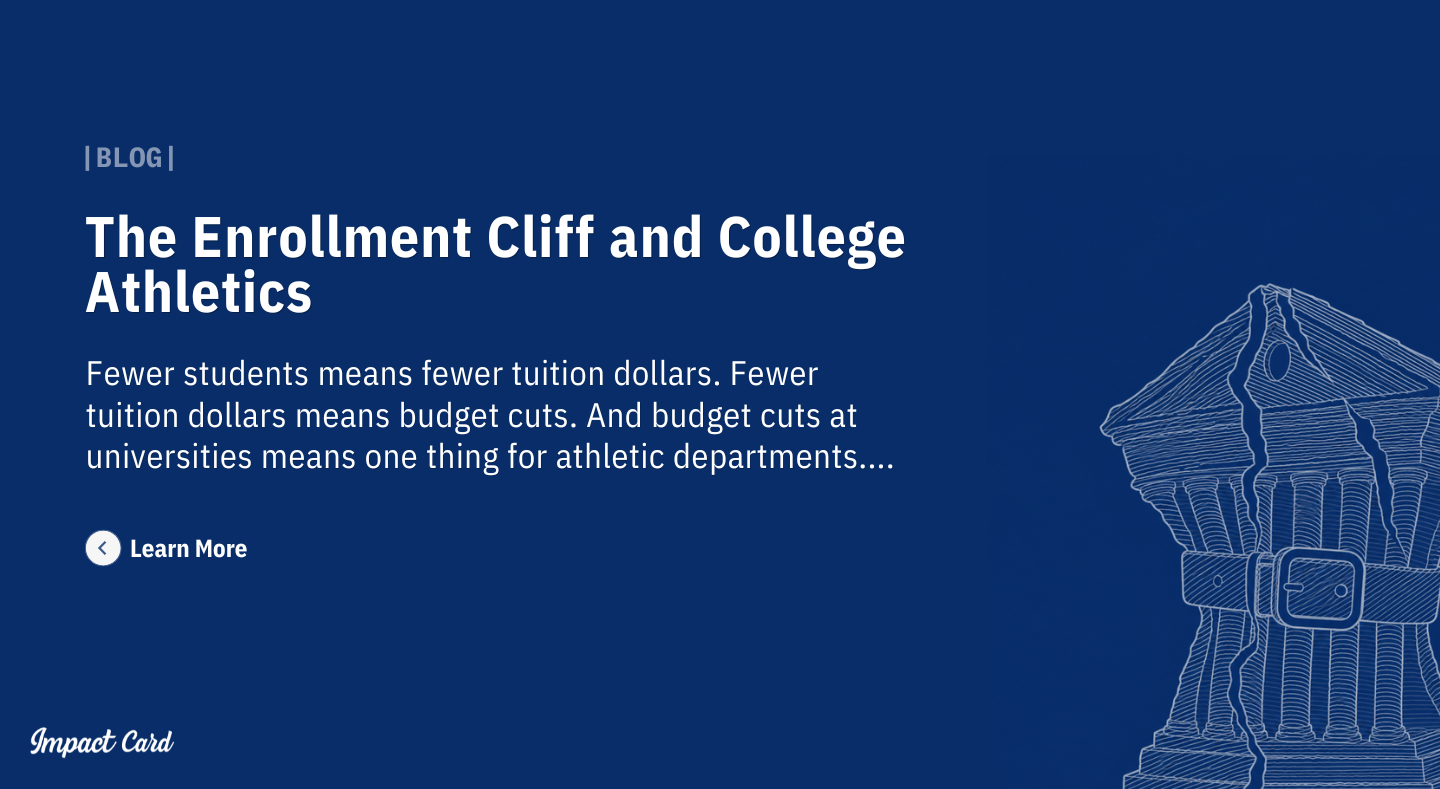
Fewer students means fewer tuition dollars. Fewer tuition dollars means budget cuts. And budget cuts at universities mean one thing for athletic departments - subsidies disappear.

The vast majority of college athletic departments do not make money. They are subsidized by their institutions. Every department outside that small group of 20 or so profitable programs depends on institutional support, student fees, and state funding to survive. That money flows from the university. And the university's financial health flows directly from enrollment.
Tony Altimore mapped this risk as well as anyone I've seen:
"Who may see financial risk from the upcoming 'demographic cliff?' Schools that rely too heavily on tuition, and are in less demand, may face enrollment declines and find themselves in a tough financial mess. This will be dramatic and result in the failure and closing of low-end, small schools - but it will also impact big schools, too. THIS WILL HAVE A BIG IMPACT ON SPORTS: Most athletic departments rely on heavy subsidies from their schools, many of whom will face big budget shortfalls in coming years."
His Demographic Cliff Risk chart used as the header of this article, which every AD and university leader should have on their wall, plots FBS schools on two axes: tuition dependency versus student demand. High selectivity, low tuition reliance: safe. Near-open admissions, high tuition dependency: danger zone. A BIG number of college athletics programs live in that lower left quadrant.
My Uncle Bill taught me a lot - I actually still have the napkins where he wrote out his lessons. A consistent theme: think with empathy.
I think about this from the chancellor's seat a lot.
You have to cut budgets and eliminate departments, which means firing people. While at the same time, you're watching athlete compensation and coaching salaries climb at rates that would have seemed absurd five years ago.
How do you square that off? At some point, you can't and something gives.
This isn't an across the board death sentence for college athletics. The Power Four programs with massive media deals and diversified revenue are largely insulated, they sit safely in the upper right of Altimore's chart.
But for regional universities, mid-majors, and smaller Division I programs, schools that are woven into the fabric of communities across this country and whose athletic departments run almost entirely on institutional subsidy, this is not just some exercise - it is a near term financial crisis.
The schools that get through this are the ones who saw it coming and stopped waiting.
They're building alternative revenue streams. Reducing tuition dependency. Finding ways to generate institutional value that don't rely on 18-year-olds showing up in the fall. They're treating this as the inflection point it is - something to get ahead of.
My professor's line wasn't cynicism. It was a lesson in how to think about problems. You can't fix the issue until you're honest about whether a bigger one is hiding underneath it.
Higher education has a bigger problem. College athletics is sitting on top of it.
The schools that survive this won't be the ones that waited for enrollment to stabilize. They'll be the ones that stopped treating outside revenue partnerships as optional and started treating them as essential and then work hard to drive that revenue.
Unfortunately, this is not business as usual for higher ed. It’s a major shift in thinking and in operations - but it represents a massive opportunity to those who get it right.
Get on the list to be notified first.

.png)