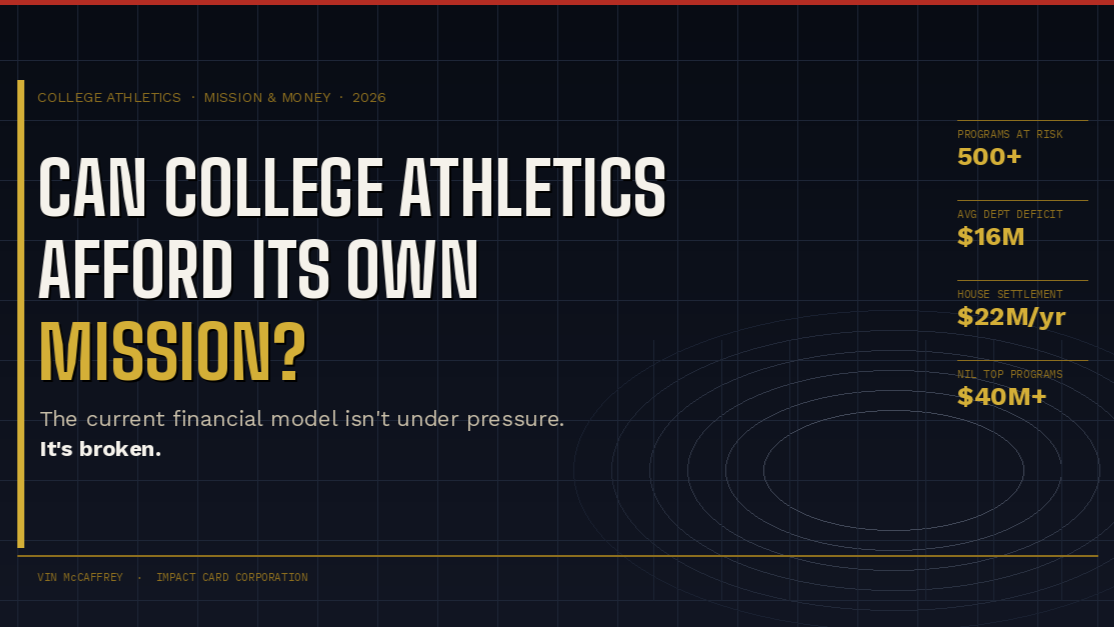
Can College Athletics Afford Its Own Mission? The current financial model isn't under pressure. It's broken.
Last Friday, President Trump convened the "Saving College Sports" roundtable at the White House. More than fifty leaders - coaches, commissioners, university presidents, legislators, and a handful of billionaires - gathered in the East Room to debate the future of intercollegiate athletics.
The urgency was appropriate - it's actually long overdue. The financial disruption facing college athletics is real, accelerating, and - this part really matters - it's structural. The House v. NCAA settlement, NIL, conference realignment, the transfer portal: these aren't temporary headwinds. They are permanent changes to the economics of college athletics.
But the conversation in that room, as important as it was, focused almost entirely on the financial crisis. Almost no one asked the prior question.
The NCAA's own mission statement answers that directly. Its stated purpose is to integrate intercollegiate athletics into higher education so that the educational experience of the student-athlete is paramount. Not competitive. Not commercially viable. Paramount.
Intercollegiate athletics exists to develop young people as competitors, as teammates, as people. Behind only the military, I believe college athletics is the greatest preparation for real life that our country offers. It extends access to higher education to students who might never have arrived on campus otherwise. It builds something lasting between universities and the communities that call them home.
I've worked in this industry for nearly twenty years. The mission has never been unclear to me. I'm one of 16 in my family who got to participate in college athletics - softball, volleyball, lacrosse, soccer, track, football, basketball, baseball. For so many families like mine, it opened doors that might otherwise have stayed closed. That is the founding logic of college athletics. And I'm concerned it has never been more at risk.
Most athletic departments, outside of a small handful of Power Four programs, operate at a structural deficit. They depend on student fees, institutional subsidies, and donor generosity to keep the lights on. That was true before the House settlement. Before NIL. Before the transfer portal.
Now layer on revenue sharing with athletes. Schools can distribute up to roughly $22 million annually under the settlement. Layer on NIL collectives at flagship programs spending north of $40 million on football rosters alone. Layer on the cost of conference realignment, of competing in a market where roster construction is now openly transactional.
The math doesn't work. Not with incremental improvement. Not with tighter budgets and better donor stewardship. The gap between what it costs to field a full athletic program and what the current revenue model generates is not a management problem. It is a structural one.
When athletic departments face that gap, they cut. And the sports that get cut - wrestling, swimming, track, gymnastics - exist almost entirely to serve the mission. They produce some of the most outstanding alumni in any program. They will never turn a profit. And so they go under the microscope.
The institutions eliminating these programs aren't making a financial decision. They're making a mission decision. Most don't realize it's a decision at all.
For decades, the implicit bargain was simple: football and basketball generate revenue, and that revenue funds the rest. Wrestling. Swimming. Track. Gymnastics. The sports that exist almost entirely to serve the mission.
That bargain is breaking down - and not just inside the athletic department.
The institutions being asked to backstop college athletics are themselves under severe financial pressure. Enrollment at US colleges and universities has declined by more than 1.5 million students over the past decade. More than 50 colleges have closed or merged since 2016. Moody's has maintained a negative outlook on the higher education sector for much of the last five years, citing shrinking enrollment, rising costs, and weakening donor pipelines.
The numbers inside athletic departments reflect this. According to NCAA financial data, the median Division I athletic department outside the Power Four runs an annual deficit exceeding $15 million - covered almost entirely by institutional subsidy and student fees. At many mid-major programs, the athletic subsidy represents 3 to 5 percent of the university's total operating budget. That is not a sustainable line item for an institution already managing declining enrollment revenue.
And the football programs that were supposed to carry everyone else? Fewer than 25 athletic departments in the country generate enough revenue to be self-sustaining. The other 325 are dependent. The House settlement and NIL arms race are now concentrating revenue further at the top, not redistributing it.
The result is a compression that puts the mission directly at risk. Campus can no longer bail out athletics. Athletics can no longer rely on football. And the sports that serve the most student-athletes - the ones the mission was actually built for - are at risk.
Federal legislation may provide structural relief around NIL and antitrust. An executive order can signal priorities. But no act of Congress fixes a broken revenue model.
If the mission is that the educational experience of the student-athlete is paramount - and the NCAA says it is, and I believe it is - then protecting that mission requires building the financial architecture to fund it. Not as a one-time fix. Structurally.
That means new revenue infrastructure. Not another fundraising campaign. Not a tighter sponsorship deal. Infrastructure that is recurring, diversified, and connected to the university's most durable assets.
Here is what I know to be true: universities are sitting on assets that generate enormous commercial value for everyone except the university. Their brand. Their alumni networks. Their student communities. Their institutional identity.
These assets are monetized constantly - by third parties, by retailers, by financial products - while the institution that built them captures just a fraction of the return.
A university's brand lives on every campus purchase, every transaction made by people who still call that institution home. That value exists. It's just flowing somewhere else.
The institutions that find ways to capture it - to build revenue streams that don't depend on a winning season, a donor's mood, or a student fee increase - are the ones that will still have twenty varsity sports a decade from now.
The question was never whether college athletics could be saved. The answer to that is yes. The question is whether we're willing to build something genuinely new to save it.
Get on the list to be notified first.

.png)